TL;DR
Most design looks good. Strategic design solves problems, and there's a difference.
The right problem only reveals itself when you ask the right questions.
We don't settle for fine. Significant change requires significant change.

Apr 22, 2026 • Five & Done Insights • 8 Min Read
Most design looks good. Strategic design solves problems, and there's a difference.
The right problem only reveals itself when you ask the right questions.
We don't settle for fine. Significant change requires significant change.
There’s no shortage of aesthetic sites and beautiful designs across the internet. Animations, gradients, and typography so clean it could pass for a skincare routine. But too often, for all the care and craft put into the design, the actual experience falls flat. It underperforms on sales, conversion rates don’t budge, and the needle doesn’t move.
Why? Because beautiful doesn't mean effective. Strategic design is what makes the difference.
So, what is strategic design then? Well, as luck would have it, you can learn everything you need to know about it from Ted Lasso:
“Be curious, not judgemental”
“Stop letting yesterday get in the way of today”
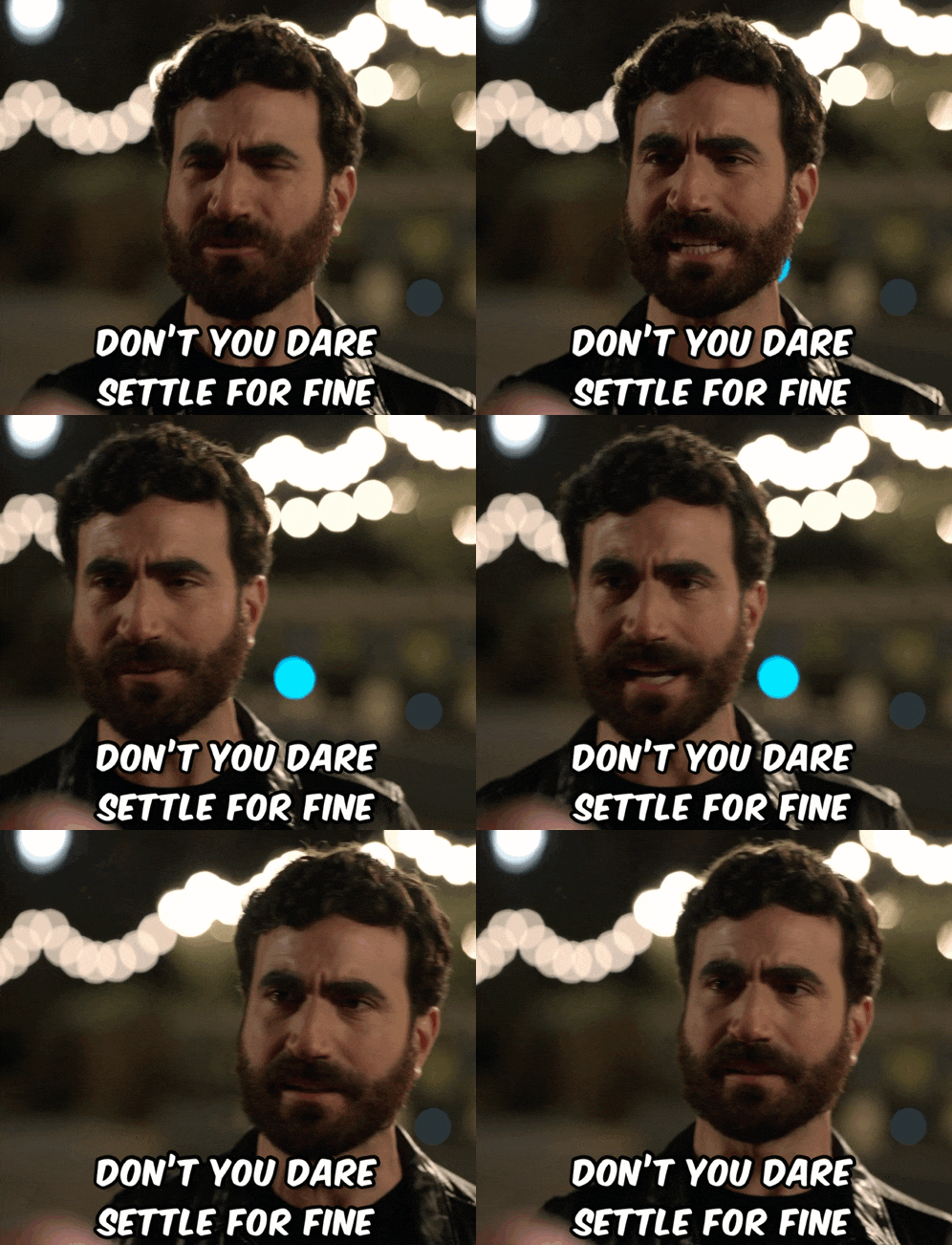
“Don’t you dare settle for fine”
In this post, we’ll get into what strategic design is, why it matters, and why your business could use a partner who bridges the gap between beautiful and effective design.
Do this right and you’ll feel the same way Ted did, "I feel like we fell out of the Lucky Tree and hit every branch on the way down, and landed in a pile of cash and Sour Patch Kids.”
Let’s kick off.
Strategic Design is design that is informed.
Imagine that you’re an e-commerce leader and you’re evaluating a re-build of your website. You’re thinking about conversion rates, outdated visual styling, shiny new competitors, new technology (cough, AI), there’s a lot on your plate and you’re being pressured for answers, so you reach out to your design partners.
“Hey, we need to redesign our site.”
Most agencies would say, “Great! Here is a high, medium, and low option to choose from!”
Strategic design asks, “Does it need a redesign, or does it need something else? What’s not working for you?”
It’s how you make sure you’re not treating symptoms when you should be addressing root causes.
In the words of Ted Lasso, “be curious, not judgemental.” Throughout our years of experience, every time we dig deeper, we find that the real problem is almost never the obvious problem.
For one client, they felt it was time for a visual refresh. But through customer interviews, we discovered the real issue: customers didn't trust the buy box. They'd spend all the time they needed on the Product Detail Page, decide to purchase the product, only to bounce at checkout and buy on Amazon instead.
For another client, their site wasn't converting visitors to leads at the rate they hoped. Through an industry-wide survey, we discovered their site was designed for top-of-funnel activities when their shoppers were far more qualified than they realized. Visitors came to the site having already done their research and ready to make a move, but there was nothing low-funnel for them there, so they churned to third-party retailers.
When you think you already have everything figured out, that’s judgement. When you realize there might be more than meets the eye, that’s curiosity.
Be curious, not judgemental. Which projects do you have that could use a curious perspective?
Strategic Design is design that accomplishes the right goals.
In order to accomplish the right goals, Ted Lasso says, “You need to stop letting yesterday get in the way of today.” That means that the “right goal” going forward may not be the same as the one you have now.
Take one of our automotive clients whose performance metric was leads submitted. That’s easy to count—but not the same thing as sales. So everything was designed to maximize form fills, not purchases.
The problem? People just don’t want to submit forms. They want to get more information, and there are better ways of doing it than submitting a form (especially in this brand new world of AI we’ve entered).
The reality is, having a North Star as something your customers actively tell you they don’t want to do is not a great North Star to have. That’s a lose-lose scenario.
Strategic design is how we make sure that doesn’t happen. It’s how we make sure everyone agrees on what success looks like before we even open Figma. After working on everything from e-commerce sites to automotive configurators, we've landed on a framework that actually holds up:
The “right” goal benefits both the user and the business by being:
Desirable – it’s a target that compels your customers to action
Reputable – it supports your authentic brand values
Valuable – it drives a measurable, bottom-line business metric
Feasible – it’s something that your business can actually carry out
Going back to our automotive client, we helped them reframe the goal: instead of a lead-generation machine, we rallied around a conversion pipeline. Instead of “more leads at any cost”, the new goal became, “uncomplicated experiences that move shoppers forward in their purchase journey”.
Suddenly, success wasn’t just about someone clicking into a form. It was about how many people felt confident enough to move closer to a purchase. Now, we could evaluate each stage of the customer journey on whether it helped shoppers move to the next stage – not on whether it moved shoppers to the final stage. That sounds like a win for the shopper and a win for the business to us.
You need to stop letting yesterday get in the way of today. What behaviors are you seeing in your organization that are getting in the way of today?
Strategic Design is design as an investment.
No commentary from Ted Lasso would be complete without a quip from the venerable Roy Kent, who said, “Don’t you dare settle for fine.” Which is exactly how we feel about the design work we do for our clients. We don’t settle for fine.
Take Fender for example. They came to us with a really interesting situation – their data showed that tons of organic traffic was landing directly on their blog articles through search engines. However, the experience that visitors had when arriving at these articles wasn't up to par with the rest of the Fender brand. Any other agency might have heard that and gotten busy styling up beautiful templates for articles content, but not us. That would have been just fine, and we don’t dare settle for fine.
Instead of jumping right into Figma, we asked, “what does ‘better’ mean to Fender’s customers?” We knew that “better” couldn’t be just better from a visual perspective, but better working, better feeling, and better converting.
Our answer came in three parts. First, we restructured articles into categories and subcategories with a new and improved taxonomy, which made it easier for visitors to discover related content and products, keeping them engaged longer on the site. Second, we created article templates that either prioritized shopping (which highlighted and upsold guitar models) or focused on education (which encouraged signups for Fender Play, their learning platform), which ensured every article had a clear conversion path tailored to the reader's intent. And third, we recommended promoting cross-platform traffic between their media channels, which created multiple touchpoints with potential customers, increasing brand familiarity and the likelihood of purchase.
In the end, the numbers backed this strategy up. As Mike Bynon, the Director of Digital Marketing, put it: “The Five & Done team came in and worked seamlessly with our systems and closely alongside our development team. Our project was a success, with conversions up 25% and e-commerce revenue up 17%. Working with them has been an amazing experience.”
Perform. That's the key word. That’s the power of aligning design to strategy—it doesn’t just look better. It performs better. Now that’s what I call a good investment.
Don’t you dare settle for fine. Where in the business do you feel like the team is settling?
Strategic design is what turns design from an expense into an investment. You're not just paying for design work—you're investing in measurable growth.
When you work with a partner who thinks strategically, you're not just getting someone who can make things look nice. You're getting:
High-level thinking that connects design decisions to business outcomes
Problem-solving that identifies the right problems, not just the obvious ones
Measurable results that prove ROI (or at least give you the data to optimize)
Alignment between what users need and what your business needs
You're getting Design that pays for itself.
Because at the end of the day, design isn't about winning awards or getting featured on blogs (though that's nice). It's about helping people do what they're trying to do — better. And if you can do that in a way that's delightful, authentic, and profitable, wouldn’t you?
That's strategic design.
If you’re ready for design that looks good in presentation and performs in the market, let’s talk about what strategic design can do for your business – hi@fiveanddone.com
As Leslie Higgins wisely states, “With the right person, even the hard times seem easy.”